Salad grows quickly, but it grows much faster when you master a few parameters that general guides overlook. Light spectrum, nutrient solution temperature, variety selection oriented towards cycle speed: we detail here the technical levers that shorten the time between sowing and harvesting in home cultivation.
Light Spectrum and Photoperiod: The Most Underestimated Lever for Indoor Salads
A south-facing window is not enough to maintain a short cycle for lettuce grown indoors. The photon flux density drops too quickly as you move away from the glass, and the short days of autumn or winter extend the cycle by several weeks.
Adjustable spectrum horticultural LEDs change the game. A spectrum enriched in blue promotes compact and rapid leaf growth, whereas a standard fluorescent light produces spindly seedlings that bolt prematurely. We recommend keeping the light fixture between 15 and 25 cm above the foliage, with a photoperiod of 14 to 16 hours per day.
This setting replicates the conditions of a late spring day, regardless of the actual season. The result: oak leaf lettuces or arugula that reach harvestable stage much earlier than in natural light behind a window. A programmable timer prevents forgetting to turn off the lights, as continuous lighting (24 hours) stresses the plant and degrades leaf quality.
For those who want to grow salads indoors with Com 2 Net, the combination of LED and controlled photoperiod remains the first parameter to set before even discussing substrate or watering.
Passive Hydroponics Indoors: Kratky Method and Vertical Towers
Growing salads in pots with potting soil works, but passive hydroponics accelerates growth in a measurable way. The Kratky method (a simple container filled with nutrient solution, without a pump) allows lettuce roots to access dissolved nutrients directly, without the bottleneck that an organic substrate presents as it decomposes.
The temperature of the solution should not exceed 22-23 °C. Beyond that, root diseases (particularly pythium) develop rapidly and jeopardize the entire crop. An opaque container, placed in a cool or slightly ventilated room, is sufficient to maintain this range.
Home vertical towers operate on the same principle, with the advantage of multiplying the cultivable surface area on the ground. They are particularly suitable for small spaces. We observe that lettuces reach harvest stage faster there than in traditional pots, provided that the conductivity of the nutrient solution is monitored (a basic conductivity meter is sufficient).
- Kratky container: fill two-thirds full, leave an air gap between the surface and the net pot for the roots to breathe
- Nutrient solution: adjust the concentration to the growth stage, more diluted at the start, more concentrated after the third leaf appears
- Renewal: top up the level without completely draining, unless the water becomes cloudy or foul-smelling
Short-Cycle Varieties for Quick Salad Harvests
Not all salads grow at the same speed. The so-called “baby leaf” varieties or those harvested as loose leaves significantly shorten the time compared to a classic head lettuce that must form a complete head.
Arugula, lamb’s lettuce, and oak leaf lettuce are among the fastest in home cultivation. Arugula germinates in a few days and offers its first harvestable leaves very quickly after sowing. Lamb’s lettuce, often associated with winter cultivation, tolerates low temperatures and grows where other varieties stagnate.
For sowing, we recommend prioritizing fresh seeds (less than two years old) and sowing on the surface or barely covered. Lettuce seeds need light to germinate properly. Planting too deeply is the most common mistake among beginners as well as experienced gardeners who reflexively apply the same depth as for root vegetables.
Staggered sowing every two to three weeks ensures a continuous harvest throughout the year, including in winter under artificial lighting. This rotation also prevents the accumulation of pathogens in the same container.
Harvesting “Cut and Come Again”: Extending Production Without Resowing
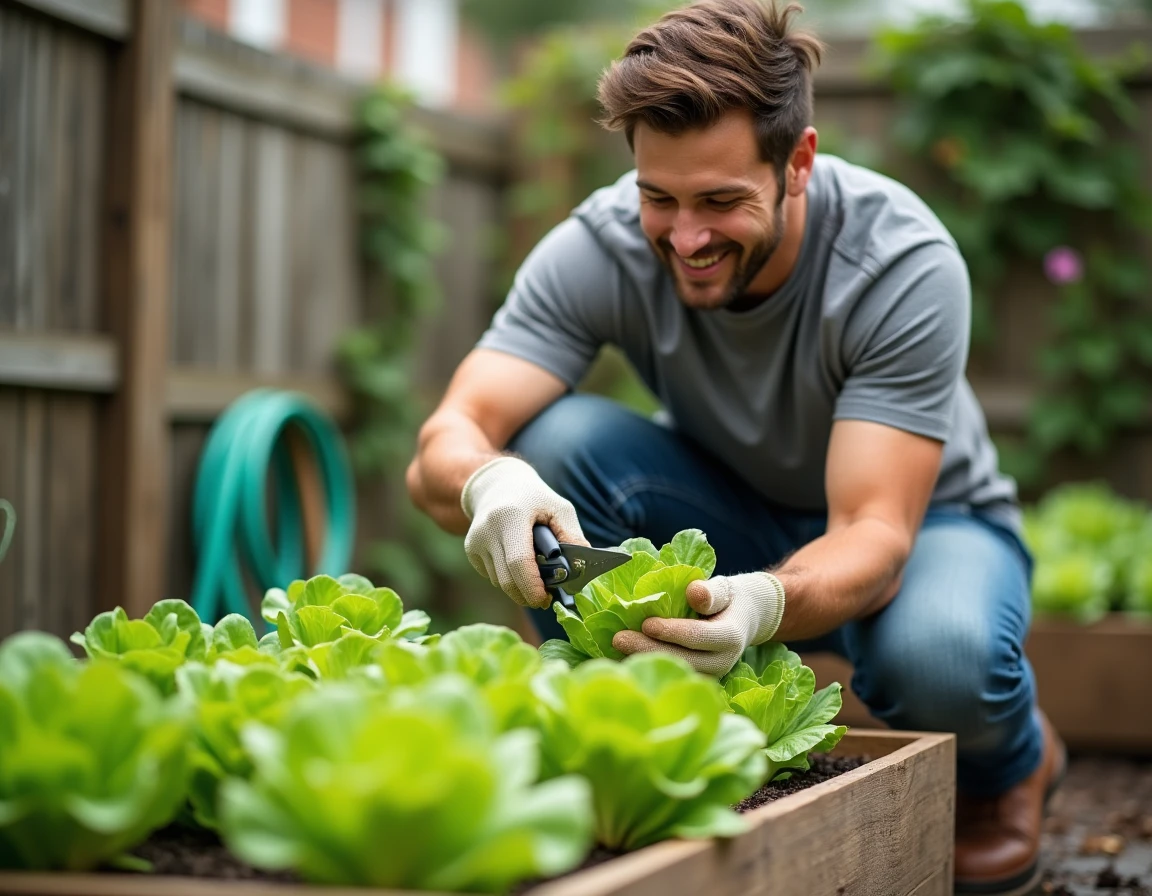
The “cut and come again” technique involves cutting the outer leaves without uprooting the plant. The heart of the plant continues to produce new leaves, allowing for multiple successive harvests from the same plant.
This method works particularly well on loose-leaf lettuces, arugula, and watercress. However, it fails with head lettuces or chicories that form a closed central structure.
- Cut the outer leaves about two centimeters above the collar, never flush
- Harvest in the morning when the leaves are full of water and still firm
- Space cuts a few days apart to allow the plant to rebuild its leaf mass
- Stop harvesting as soon as a flower stalk appears: the plant bolts and the leaves become bitter
One plant can provide three to five harvests before exhausting itself or bolting. This yield, when compared to the surface of a simple pot on a windowsill, makes indoor cultivation competitive with supermarket purchases, both in freshness and variety diversity.
Indoor salad cultivation relies less on the volume of soil or the size of the container than on the precise management of light, temperature, and variety selection. A plant of arugula under LED, harvested as loose leaves, produces its first leaves well before a head lettuce in an outdoor garden. The time savings come from these technical details, not from adding fertilizers or purchasing expensive equipment.