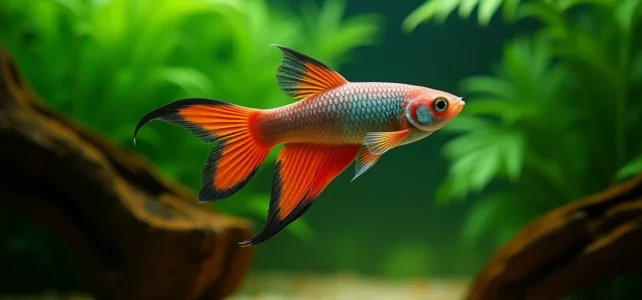
The swordtail, or Xiphophorus hellerii, is a freshwater fish from the Poeciliidae family, native to the Atlantic coast of Central America, from Mexico to Honduras. Its nickname “swordtail” comes from the blade-like extension that the male displays on its caudal fin. Behind its reputation as an easy fish to keep in an aquarium lies an organism whose biology surprises well beyond the glass tank.
Swordtail and cancer research: a laboratory fish
Aquarium care sheets detail the colors, tank size, and water temperature. They overlook a major fact: the genus Xiphophorus has served as a model in cancer research for several decades.
Hybrid lines of swordtails are studied to understand UV-induced skin tumors in vertebrates. The Xiphophorus Genetic Stock Center, affiliated with the University of Texas, maintains these lines and contributes to publications in journals such as G3: Genes, Genomes, Genetics and Cancer Research between 2020 and 2024.
The interest in this model lies in the ease with which certain crosses between species of the genus produce reproducible melanomas. This mechanism, linked to specific genes activated during hybridization, allows for the study of tumor genetics without resorting to more complex organisms. The swordtail fish thus occupies a unique place at the intersection of home aquaristics and biomedical research.
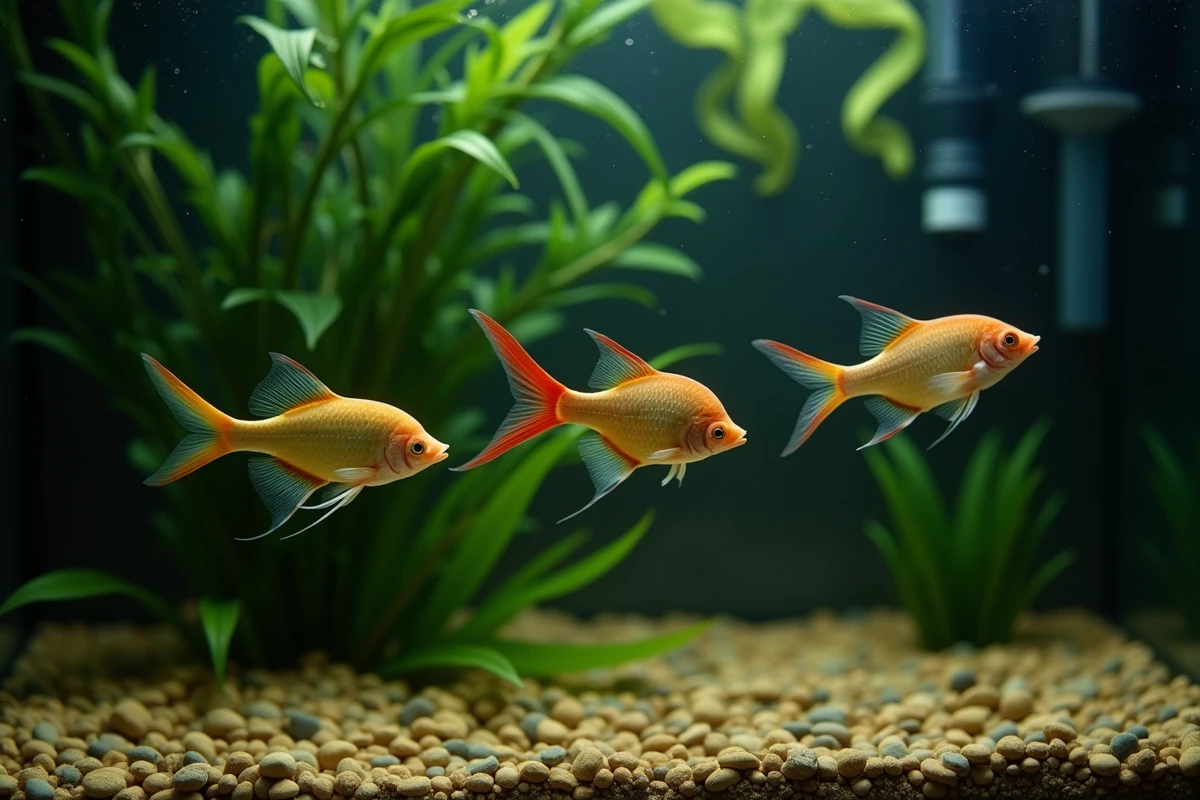
Breeding hybridization: why pet store swordtails are no longer wild swordtails
A swordtail purchased from a pet store bears only a vague resemblance to its Central American ancestor. Commercial strains are heavily hybridized with X. maculatus and X. variatus, two closely related species of the same genus. These crosses, practiced for generations to obtain bright colors or modified fins, have produced forms very distant from natural populations.
Finding a genetically “pure” Xiphophorus hellerii in commerce has become nearly impossible. The work of M. Schartl and his collaborators, published in the Journal of Fish Biology and Evolutionary Applications since 2019, documents this genetic drift. The consequences go beyond aesthetics: certain behaviors, such as the level of aggression between males or the frequency of reproduction, vary according to the degree of hybridization.
The genetic pollution of wild populations
The problem is not confined to aquariums. Studies published in Biological Invasions between 2020 and 2023 report the introduction of alleles from farmed swordtails into wild populations in Mexico. Escapes from breeding and voluntary releases are the main causes.
Genes from domestic strains mix with the wild genetic heritage, which can alter the local adaptation of natural populations. For a fish whose range covers about 2,200 km according to Fishbase data, this genetic pressure poses a real risk to the diversity of subpopulations.
Xiphophorus hellerii invasive species: an out-of-control swordtail
The swordtail is among the aquarium fish most frequently released into the wild around the world. Feral populations have established themselves in many tropical and subtropical countries, well beyond its Central American range.
Its adaptability explains this expansion. The swordtail tolerates a wide range of physicochemical parameters and reproduces quickly thanks to its ovoviviparous mode: the female gives birth to fully formed fry, without going through an egg stage exposed to predators. Gestation lasts four to six weeks and can produce several dozen fry per brood.
- Direct food competition with local species of small fish and invertebrates, as the swordtail is omnivorous and opportunistic.
- Risk of transmitting parasites and exotic pathogens to indigenous faunas that have never been exposed to them.
- Possible hybridization with other local Poeciliidae in regions where these families coexist, blurring endemic lineages.
Several countries have implemented regulatory restrictions on the importation or possession of swordtails, although the enforcement of these measures remains uneven. In Australia, for example, the species is classified as invasive in certain states.
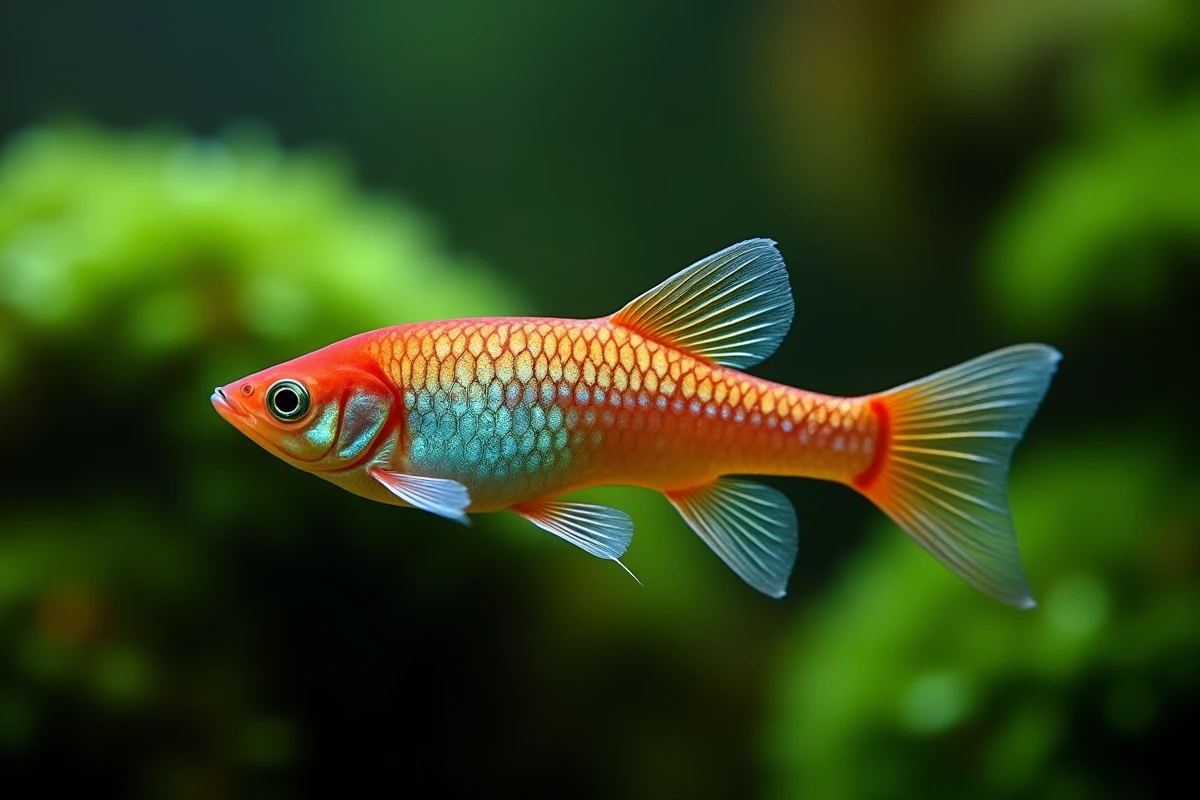
Sexual dimorphism and sex change in the swordtail
The male can be recognized by two distinctive traits: the sword-like extension of the caudal fin, edged in black, and the gonopodium, a modified anal fin that serves as a reproductive organ. The female, larger (she can exceed the male in size), has a dark spot on her belly, visible especially during gestation.
A more puzzling phenomenon has been documented in this species: some females develop a caudal sword and male behavior later in life. This change, sometimes referred to as “sex reversal,” remains rare and its mechanisms are not fully understood. It is not a true sexual inversion in the strict hormonal sense, but rather a late masculinization related to complex genetic factors.
Social behavior in the aquarium
The swordtail is often described as peaceful. The reality depends on the male/female ratio in the tank. Keeping several males together without enough females leads to incessant chasing and stress. A ratio of one male to two to three females is commonly recommended by experienced breeders.
The swordtail is also a lively fish, capable of jumping out of the aquarium if it is not covered. A volume of at least 150 liters for a group of about ten individuals provides the necessary space for social hierarchy to establish without the subordinates being constantly harassed.
The swordtail remains one of the few domestic fish that simultaneously occupies the shelves of pet stores, cancer genetics laboratories, and invasive species lists across several continents. This triple role makes it a far more complex organism than its care sheet suggests.