
People often buy a vacuum sealer after throwing away a poorly packaged batch of meat in the freezer for the third time. Frost sets in, the texture changes, and the taste disappears. The real trigger isn’t the desire for a gadget; it’s a concrete loss that we want to avoid. Choosing the right vacuum sealer to keep your food fresh longer requires looking beyond product specifications and asking the right questions about your own usage.
Bags, jars, or boxes: the type of packaging determines the choice of vacuum sealer
Before comparing models, we start with what we want to package. A flexible bag is suitable for a cutlet or a fillet of fish. For marinated vegetables or a liquid dish, a glass jar or a rigid box completely changes the game.
Not all machines handle both. Entry-level models often limit themselves to bags. If you regularly prepare jars of soups or sauces, you need to check that the device has a suction nozzle compatible with appropriate lids. This criterion has become a real sorting factor: more and more user feedback is explicitly looking for a machine capable of vacuum sealing both bags and glass jars.
To compare the different categories of devices and their compatibilities, a useful resource is: https://www.machine-sous-vide.xyz/, which brings together the main families of machines available on the market.
External suction or chamber machine: two approaches to vacuum sealing
The choice between external suction and chamber machine is not just a budget question. It’s a matter of volume and frequency of use.
External suction works by sucking air directly through the opening of the bag. The device is compact, easy to store, and suitable for typical home use: a few portions per week, meats to freeze, leftovers to protect. The limitation appears when you want to package liquids or delicate foods. The suction can crush a delicate product or suck out juice before sealing.
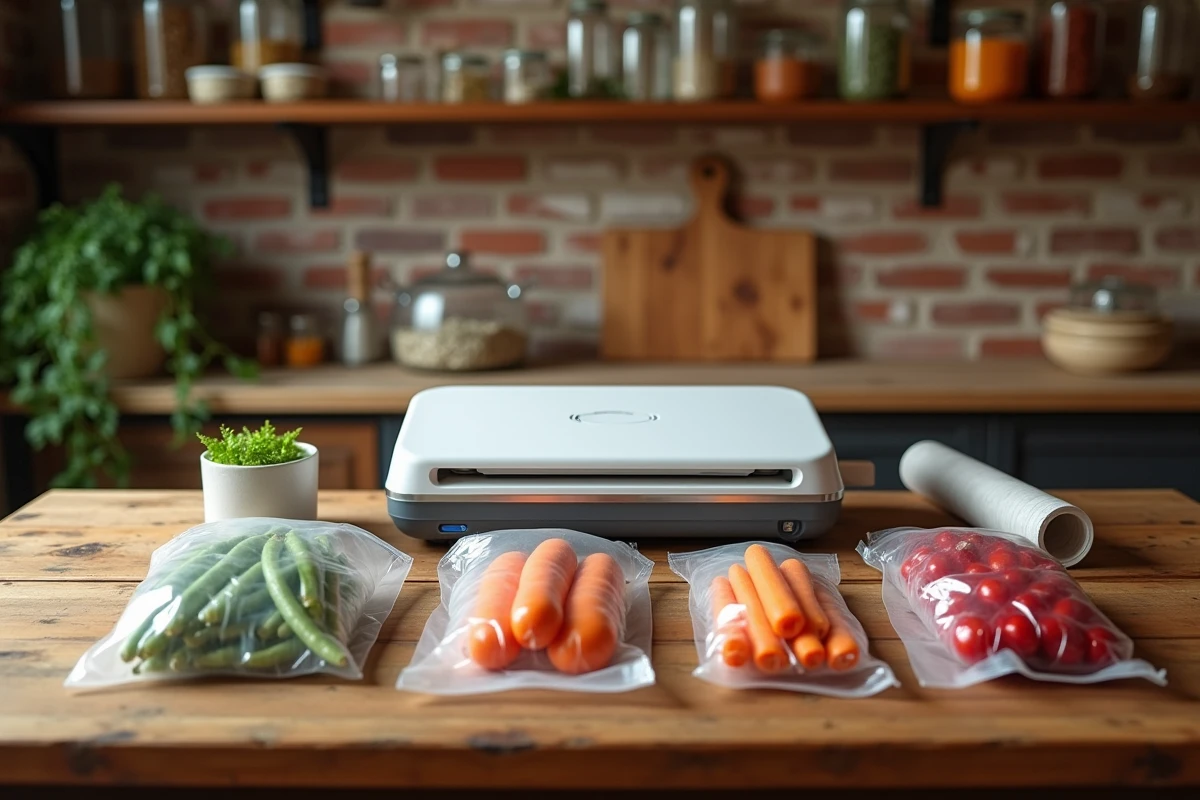
The chamber machine places the entire bag in a closed chamber. Air is removed from the entire chamber, not just the bag. The result: the pressure is uniform, liquids do not rise, and sealing is done under better conditions. In return, these devices are heavier, bulkier, and significantly more expensive. They are found in professional kitchens or among individuals who practice sous vide cooking intensively.
The case of batch cooking
For those who prepare their meals in advance for the entire week, the vacuum sealer becomes a tool for organization as much as for preservation. You can package five or six portions in a single session. In this case, the speed of suction and the length of the sealing bar matter more than raw power. A short seal forces you to fold or cut the bags, which slows down the process and wastes consumables.
Quality of vacuum bags: the parameter that technical sheets ignore
You can invest in a high-performance machine and achieve mediocre results if the bags are of poor quality. The actual performance depends as much on the consumables as on the device itself.
A bag that is too thin allows micro-perforations when in contact with a bone or an angular food. Air gradually enters, compromising preservation in a few days. Embossed bags (with raised stripes) are essential for external suction machines, as the grooves allow air to circulate towards the suction nozzle. A smooth surface simply does not work with this type of device.
Here are some concrete guidelines to evaluate your bags:
- A sufficiently dense weight to withstand contact with fish bones or poultry bones without micro-perforation
- Certified food compatibility, especially if you practice sous vide cooking (the bag must withstand the heat of the water bath)
- Dimensions suitable for your sealing bar, to avoid systematic cuts that increase the cost per portion
Maintenance and durability: what makes a food vacuum sealer last
A point often overlooked at the time of purchase. The ease of cleaning directly affects the lifespan of the device. Food residues in the sealing area cause incomplete closures. Juice sucked into the pump can damage it irreversibly.
Cleaning the sealing bar and the suction area after each use is not a theoretical recommendation. On external suction models, a simple wipe with a damp sponge is sufficient. On chamber machines, the chamber must be wiped and dried to prevent corrosion, especially on entry-level stainless steel models.
Storage also matters. Storing the machine in a damp cupboard or leaving it near a hot plate shortens its lifespan. A dry and ventilated location is the minimum.
Signs of wear to watch for
When the seal begins to fail on new bags of good quality, it is often the heating wire or the seal of the sealing bar that is wearing out. On most home models, these parts are replaceable for a few euros. Checking the availability of spare parts before purchase prevents throwing away a functional device due to a worn seal.
Feedback varies on this point depending on the brands: some easily provide the parts, while others make replacement nearly impossible.
Choosing a vacuum sealer is primarily about clarifying what you are packaging, how often, and with what containers. An external suction device with good embossed bags covers the majority of domestic needs. The chamber machine is justified for regular volumes or liquid management. In any case, the quality of the bags and rigorous maintenance after each use will do more for the preservation of your food than the power displayed on the packaging.